• US/Iran conflict. Weekend talks ended without an agreement. Energy prices jumped this morning. USD firmer. AUD & NZD lose ground.
• Macro risks. US threatens to blockade the Strait of Hormuz. Downside risks to global economy remain. Volatility expected to continue for a while yet.
Global Trends
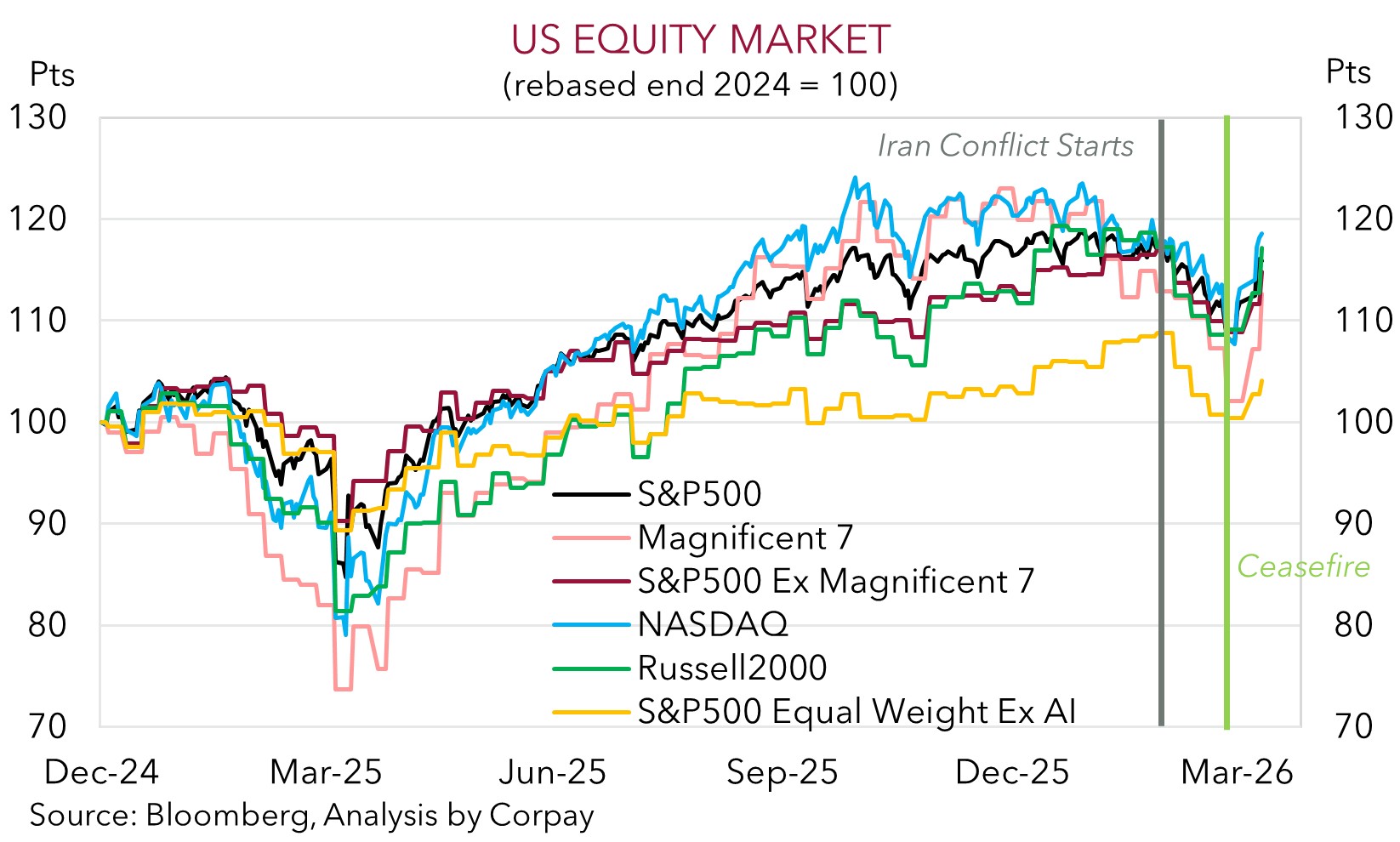
Market sentiment was underpinned last week by the US/Iran ceasefire news. There was a solid rebound in global equities (the S&P500 rose ~3.6% last week, its best weekly result since last November), bond yields declined, and oil prices pulled back. However, hope can only go so far. Weekend developments have once again highlighted how fragile the situation in the Middle East is. Talks between US and Iranian officials in Pakistan ended without an agreement. According to Vice President Vance Iran would not commit to not seeking a nuclear weapon, a key ‘red line’ for the US. In response, President Trump stated the US will blockade the Strait of Hormuz. This could further exacerbate global oil/energy supply concerns and cut off a financial lifeline for Iran given it has continued to export oil on par with levels prevailing before the conflict kicked off. It has also been reported President Trump is weighing up ‘limited strikes’ on Iran, raising more doubts the ceasefire will hold.
Nervousness and negative risk sentiment has returned to markets in this morning’s early Asian trade. US equity futures have opened lower (S&P500 futures -1.2%), and energy prices have jumped with brent crude oil rising ~8% to be back near US$103/brl. In FX, the USD has recovered a bit of last week’s lost ground with EUR slipping back (now ~$1.1675) and USD/JPY edging up (now ~159.68). Cyclical growth linked currencies such as the NZD (now ~$0.5808) and AUD (now ~$0.7007) have started the week under pressure.
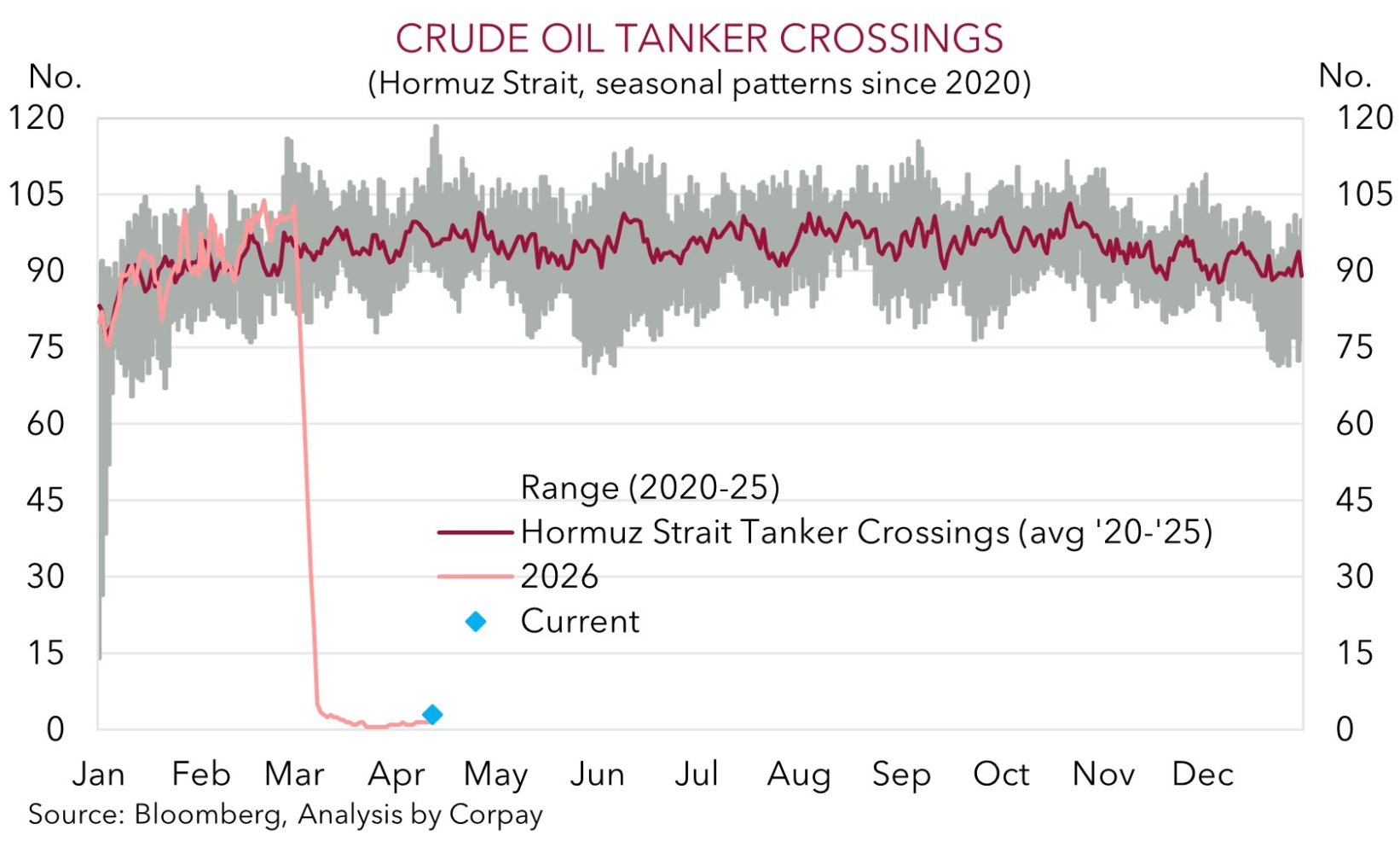
As discussed last week, and shown by recent events, the situation in the Middle East is fluid and given the players involved bursts of market volatility should be anticipated for a while yet. Indeed, in terms of the conflict, the risks seem tilted to things deteriorating in the near-term. Fundamentally, more longer-term underlying issues remain for the global economy such as the flow of energy/vessels via the Strait of Hormuz (recall ~20-25% of the worlds energy is shipped via the Strait, and ~85-90% of these shipments are sent to Asia (the engine room of the global economy)). As mentioned previously, we think these fundamental issues could, at best, take months/quarters to clear up, not days/weeks. Hence the economic fallout from the conflict is closer to the beginning than the end. A blockade of the Strait of Hormuz only reinforces this assessment. Over coming months global growth seems set to be weaker and inflation higher than where it was predicted at the turn of the year. The uneasy global backdrop, coupled with elevated oil prices (given the US’ swing to becoming a ‘net energy exporter’) can be USD supportive over the short-run, in our opinion.
Trans-Tasman Zone
After rebounding last week on the back of the improved sentiment and a weaker USD stemming from the US/Iran ceasefire, the AUD and NZD have dipped this morning on news weekend talks ended without an agreement (see above). At ~$0.7007 the AUD is a little above its ~1-month average, as is the NZD (now ~$0.5808). The AUD has also given back ground on the major cross-rates with AUD/EUR hovering near ~$0.60, AUD/CNH back around ~4.80, AUD/JPY close to ~112, and AUD/NZD tracking close to ~1.21.
Data wise this week the focus offshore will be on US producer price inflation (Tues night AEST) where the surge in energy prices should start to show up, and Q1 China GDP (Thurs AEST). China GDP will give a read on whether policy support is gaining traction. Locally, Australian business conditions (Tues) and the monthly jobs report (Thurs) are due. The reference week for the March jobs data is early in the month; hence the timing of Easter shouldn’t cause issues. We expect the latest employment figures to show that labour market conditions remain ‘tight’, reinforcing the case for the RBA to raise interest rates again as soon as the 5 May meeting. Markets are pricing in a ~68% chance the RBA hikes rates in May with a move fully discounted by June, and ~3 increases baked in by next March.
That said, global events, particularly the situation in the Middle East, should remain in the AUD driver’s seat in the short-run. As discussed last week the risks facing the global economy haven’t been extinguished with the weekend news illustrating how fragile the situation still is. As mentioned above, the impact on supply-chains and global energy could take some time to rectify. This in turn can continue to act as a handbrake on global activity, particularly across Asia. We believe that given how much more RBA tightening is already factored into the Australian interest rates curve, the lingering global growth headwinds, and with negative domestic consequences of higher mortgage rates and fuel costs in the pipeline, there are more downside than upside risks for the AUD over the near-term.